In most of the families we teach, German comes from one person. One parent speaks it, the other does not, and everything outside the front door happens in English. That parent carries the whole language on their own, and after a few years many of them quietly start to wonder whether it is working at all.
It usually is working better than they think. But there are a few things that decide whether a child keeps the language or lets it go, and none of them is about talent.
The child needs a reason, not a rule
Children are practical. If both parents understand English, and English is faster, a child will use English. Not out of laziness, but because language is a tool and they pick the one that works. Telling a child to speak German because it is important to you is a rule. Rules get obeyed for a while and then quietly dropped.
What lasts is a reason. Grandparents who speak no English are a reason. Cousins who write back are a reason. A holiday where nobody helps you order ice cream is a reason. So is a book series the child loves that only exists in German. Your job is less to insist and more to make sure German is attached to people and things your child actually wants.
Be consistent about who, not about how much
The advice you will read online is one parent one language, and it is good advice, but it is often taken too strictly. Nobody manages it perfectly, and families who try usually end up feeling like they have failed.
The part that matters is that your child knows which language belongs to you. If German is simply what happens when the two of you are alone, that is enough structure. It does not have to survive dinner with English-speaking guests, and it does not have to be enforced when your child is tired or upset. A child who is crying should be comforted in whatever language reaches them fastest.
Answer in German, do not demand German
The most common moment where it breaks down is this one. You ask something in German. Your child answers in English. You say, in German, please.
Try not doing that. Instead, simply continue in German, and if the answer was worth repeating, repeat it back in German as if you had understood perfectly, which you did. Your child hears the German version of their own thought without being corrected, and the conversation keeps going.
This matters because the alternative teaches a child that speaking German with you is a negotiation. A child who has to pass a test every time they open their mouth will speak less, not more.
Passive German is not failure, it is storage
Plenty of children understand everything and answer in English. Parents often describe this as the child having lost the language. They have not. Understanding is the larger half of knowing a language, and it is the half that is hardest to build.
Children in this state can switch to speaking surprisingly quickly when the situation demands it, most famously during a few weeks with German-speaking family. What they need is not more pressure at home but an occasion where German is the only option. That is one of the reasons we run our Saturday playgroup: for ninety minutes, the other children are speaking German too, and it stops being the language of one parent.
Reading is the part that will not happen by itself
Speaking is absorbed. Reading has to be taught, and if your child goes to school in English, nobody is teaching them to read German. This is the single biggest gap we see, and it usually stays invisible until a school report or a family visit exposes it.
The good news is that German spelling is regular, so a child who already reads English can learn to read German far faster than they learned the first time. We wrote a separate piece on how to help your child read German at home, including which materials are worth buying.
Ten minutes a day beats an hour on Sunday
This is true for reading, for vocabulary, for everything. Frequent short contact builds language. Long rare sessions build resistance. Ten minutes in the car, a page at bedtime, one voice message to Oma. It adds up in a way that looks like nothing on any given day.
Get someone else involved before you get tired
The reason we say this is not to sell lessons. It is that the single parent carrying a language tends to hold on until they are exhausted and then stop, and the language goes with them.
A teacher changes the dynamic in two ways. German stops being a thing between you and your child, which removes a lot of quiet conflict from your evenings. And the child sees that German is something other people use too, not a private habit of one parent.
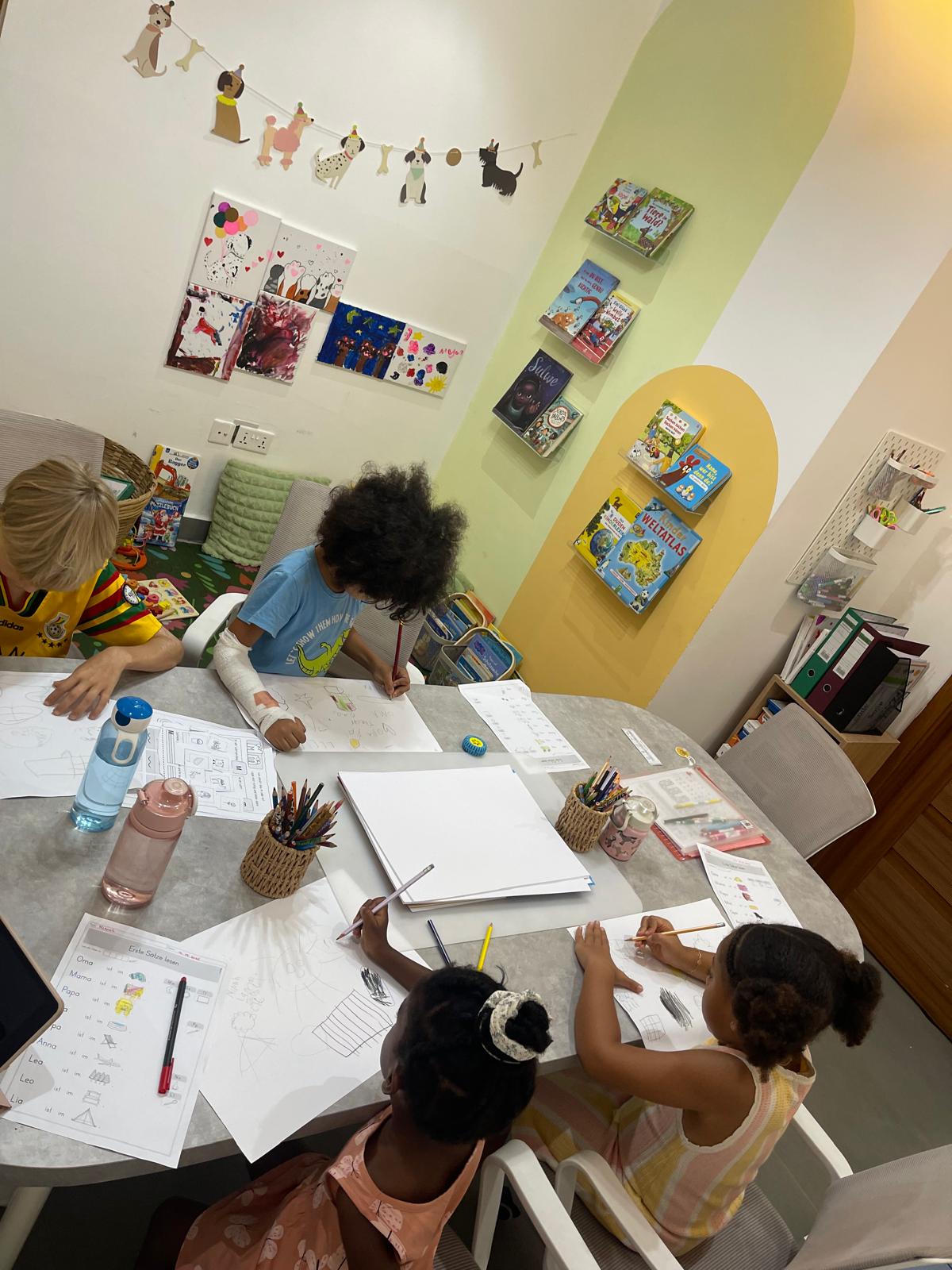
At Studyfreunde we teach in groups of no more than four, so children get real speaking time rather than one turn per lesson. Our German classes for children and teenagers and our early learning group for ages three to five are built for exactly these families. You can see when the groups meet on the timetable.
What to do this week
Pick one. Not all of them. A voice message to a German-speaking relative, every Sunday. Ten minutes of reading together, five days a week. Or one thing your child loves that exists only in German. Changes in language habits fail when they are ambitious and survive when they are small.
If you would like to know where your child actually stands, come to a free trial lesson at our centre in Airport West, Accra. We will talk with your child, and tell you honestly what we hear. There is no obligation afterwards, and you can write to us in German or in English.